Designing a Scent Experience for a Men's Line: Mistakes to Avoid
A scent experience only earns its floor space if a visitor walks out remembering a smell, not a room. For a men's brand the test is harder, because fragrance is often bought fast, as a gift or a restock, and the curiosity a museum visit generates is exactly what an e-commerce listing cannot produce. Design the journey around the fragrance itself, connect it to something the visitor can take home, and measure it like any other channel. Most failures come from treating the format as decoration instead of as the product.
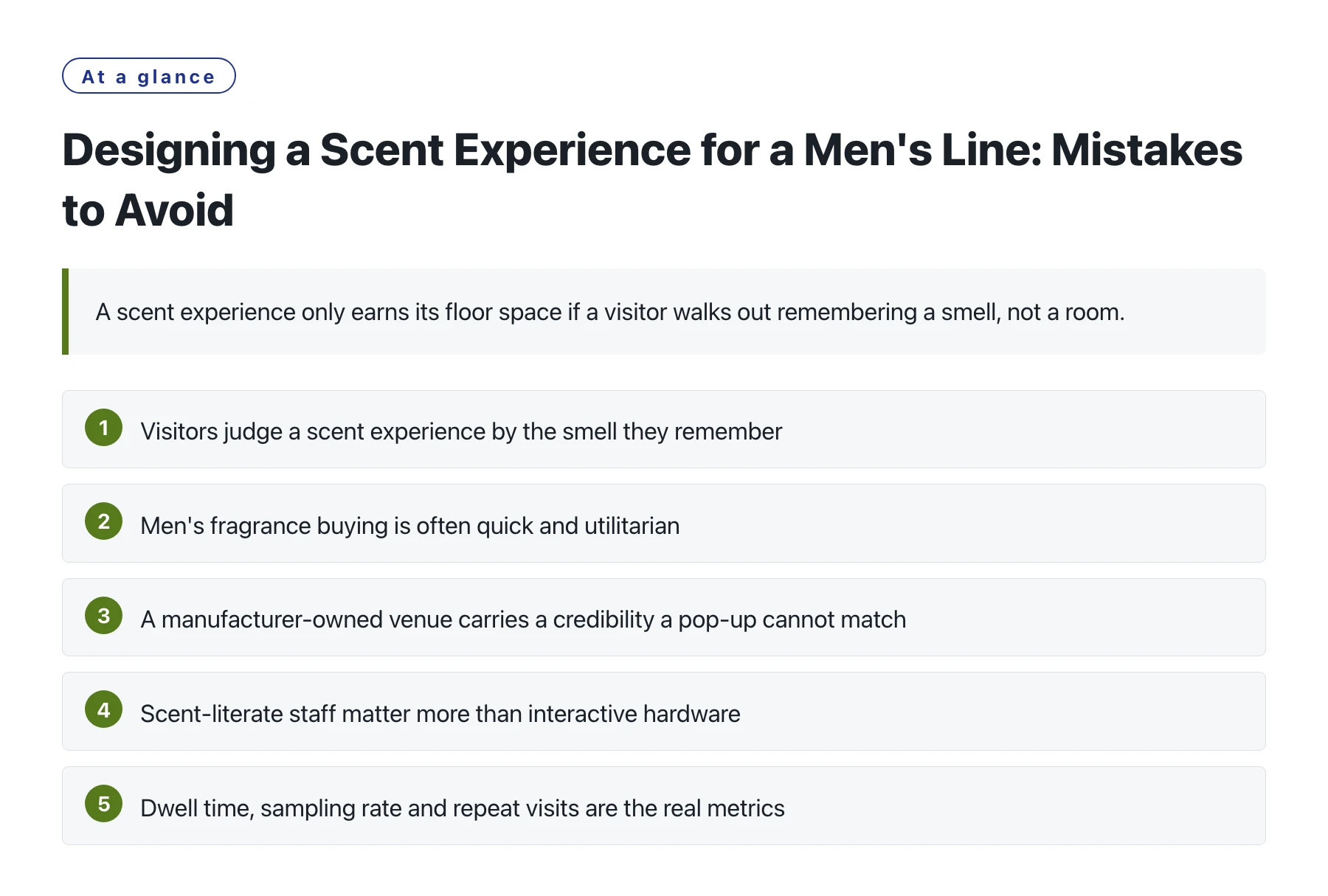
Key takeawaysVisitors judge a scent experience by the smell they remember, so the olfactive journey has to be designed before the decor, the screens or the architecture. · Men's fragrance buying is often quick and utilitarian, so the experience must hand over something portable - a sample, a QR link, a discovery set - before the visitor leaves. · A manufacturer-owned venue carries a credibility a pop-up cannot match, but only if the brand ties the exhibition back to its own products and production. · Scent-literate staff matter more than interactive hardware; a guide who can describe what you are smelling turns a walk-through into a conversation. · Dwell time, sampling rate and repeat visits are the real metrics; without them a scent experience is marketing theatre, not brand infrastructure.
Most men's fragrance launches start with a bottle, a brief and a retail listing, and the scent is discovered on a card in a department store or on an influencer's wrist. That works, but it leaves the deciding moment to chance: the shopper who needs to smell before buying has no real place to do it.
Scent experiences - museum-style spaces, scent bars, immersive walk-throughs - are the way brands take back control of that moment. The format has been around long enough that the honeymoon is over: shoppers have seen the interactive screens and the scent stations, and the props no longer impress them.
This article walks through the mistakes that keep a scent experience from working for a men's line, and what to put in their place.
Why the smell has to come first
A scent experience is museum-like only in the sense that it earns trust through depth: visitors stay longer when the journey explains something - where the raw materials come from, how a fragrance is built, why a note behaves differently on skin. When a fragrance manufacturer opens its own space, as with the fragrance museum in Guangzhou that Xuelei runs, the setting is credible precisely because the people who make the product are the same people who built the exhibition; the company describes the venue as the largest of its kind. There is a professional standard to borrow here too: ICOM, the international body for museums, maintains a formal museum definition and a code of ethics, and its core idea - that a museum exists to serve its community rather than to display objects - is the right yardstick for any brand-owned space [1].
For a men's line the same logic applies at a smaller scale: a scent bar in a flagship, a guided test at a retailer, a touring installation tied to the launch. What does not scale is a room full of visuals that never asks the visitor to close their eyes and smell anything. If the visitor cannot describe what they smelled when they leave, the experience did not happen.
The mistakes, in order of cost
Designing for the eye instead of the nose
The fastest way to spend a scent budget is on visuals. Installations look excellent in launch press and in the influencer reel, but the shopper's memory is olfactive; a walk-through that never stages the smells in sequence produces content, not conviction.
Treating the venue as a one-off event
A pop-up that disappears after three weeks leaves no asset behind. Brands that keep a smaller permanent corner, or reuse the same guidance in every retail test, compound their learning; the ones that treat the event as an end in itself start from zero next season.
Forgetting that men's buying is fast
Men's fragrance is disproportionately bought as a gift or a stock-up, often in minutes rather than hours of browsing. The experience has to resolve inside that window: smell, decide, walk out with something. A journey that demands a forty-minute tour from a shopper with ten minutes was designed for the wrong customer.
Underinvesting in the people who talk about scent
The person who hands over the sample is the experience. Guides who can name a note, explain a top-to-base structure and steer a customer away from a scent that will not work on their skin convert far more than any screen. Scent literacy is trained, not hired - some manufacturers run their own programmes, such as the professional scent training offered through their academies, and a partner brand's counter team can sit in on them.
Mistake to fix, at a glance
| Mistake | Why it fails | What to do instead |
|---|---|---|
| Visual first, smell later | The visitor leaves with an image, not a smell | Prototype the olfactive sequence before any carpet or lighting is specced |
| One giant event, no residue | The investment evaporates with the pop-up | Keep a permanent corner or a repeatable touring format |
| A 40-minute journey for a 10-minute shopper | Men's purchases are often quick, gift-driven decisions | Offer a fast path: smell, sample, leave within minutes |
| Untrained guides, heavy hardware | Hardware cannot answer what the scent does on skin | Train staff to describe scent; make a guided sniff the core act |
| No measurement | Nothing survives to justify the next budget | Track dwell time, sampling rate and repeat visits per week |
If three of these five rows ring true, the experience is probably succeeding as a photo opportunity and failing as a sales channel. Fix the smell-first sequence and the portable takeaway before touching anything else.
Two assets most men's brands leave unused
The first is the factory itself. Visitors trust a scent they can trace to a place: raw materials in, concentrate blended, bottle filled, carton sealed. A manufacturer that keeps compounding, filling and decorating as one operation - one-stop fragrance manufacturing - can open those doors without inventing a story, and the tie-in is commercially honest: the brand that shows production usually sells more at the exit. For a men's line that tour-with-a-twist is exactly the content a gift shopper retells.
The second unused asset is interpretation. Industry bodies keep pushing museums toward community value over collections: the Museums Association's own vision is of inclusive, participatory institutions at the heart of their communities, which is a fair description of what a scent experience should be for its customers [2]. Translate that into a men's line as a question the visitor can answer - which scent do I wear tomorrow, to a meeting, to dinner, to the gym? - and the exhibition stops being background noise and starts being advice.
Both assets share one feature: they cannot be faked in a press release, and they pay out only when the experience is treated as infrastructure with a repeat budget, not as a launch spectacle.
The question that decides everything: if the experience closed tomorrow, would the brand still know what its customers smell like? If not, it was decoration. If yes, it was infrastructure - and it deserves next year's budget.
Sources
- ICOM — International Council of Museums —— The international organisation representing museums; publishes the ICOM museum definition and professional standards for museum practice.
- Museums Association —— A professional body for museums, publishing guidance and research on museum practice and visitor experience.
Frequently asked questions
Do scent experiences make sense for a small men's fragrance brand?
At full museum scale, no, but the principles scale down to a counter, a scent bar or a touring kit. The budget question is not square metres; it is whether the experience hands the visitor a smell they remember and something they can take away.
Should visitors pay for entry?
Paid entry filters for curiosity and funds the space, but it also suppresses the gift shopper, who is a large share of men's fragrance buying. Most brands keep walk-ins free and charge for guided or deep-dive sessions.
How do you measure a scent experience?
Track dwell time, sampling rate, the share of visitors who take a sample or scan a link, and repeat visits. Compare sampling-to-purchase conversion against your other acquisition channels; an experience that converts worse than paid media has a design problem, not a budget problem.
Is a fragrance museum just marketing?
It becomes marketing the moment it stops teaching anything. Museum practice itself - the professional definition and ethics maintained by ICOM - insists a museum serves its community rather than merely displaying objects, and that standard is a useful check for a brand-owned space too.
How long does it take to plan a scent experience?
A counter or scent bar can be briefed and built within a season. A permanent space is an eighteen-month-plus project with a property decision at the start. Plan the olfactive content first; it is the one part that cannot be rushed.